


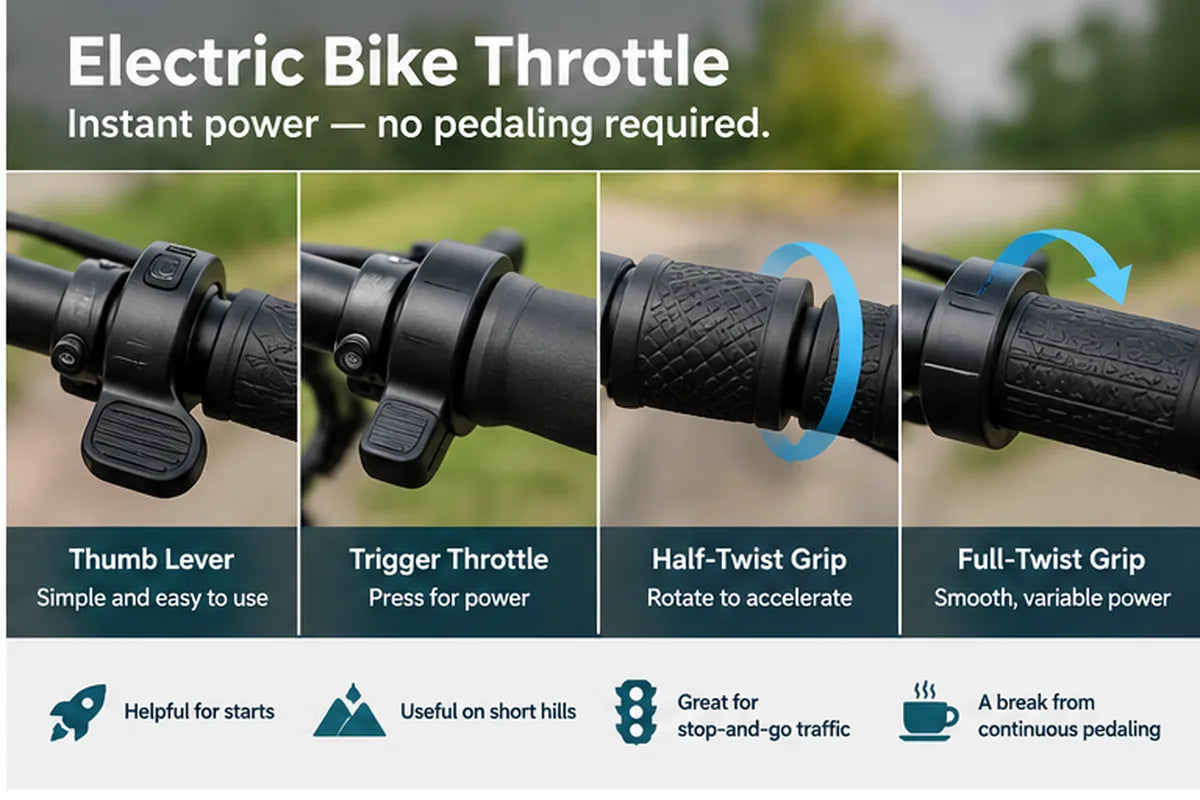
Electric bikes do not all deliver power in the same way.
Some provide motor assistance only after the rider begins pedaling. Others can move when the rider presses a thumb lever or twists a grip. Many models combine both systems, allowing the rider to switch between active pedaling and on-demand motor power.
This leads to an important comparison for new buyers:
Pedal assist vs. throttle—which is better?
There is no universal winner. Pedal assist usually creates a more natural cycling experience and encourages the rider to contribute more physical effort. A throttle provides immediate power and can be convenient for starting, short hills, stop-and-go traffic, or brief breaks from pedaling.
The right choice depends on how, where, and why you plan to ride.
What Is Pedal Assist on an Electric Bike?
Pedal assist, often abbreviated as PAS, is a system that activates the motor when the rider pedals.
A sensor detects pedal movement or pedal force. The controller then instructs the motor to provide assistance based on the selected support level.
Most pedal-assist e-bikes offer several settings, such as:
- Eco
- Level 1
- Level 2
- Level 3
- Sport
- Turbo
The names vary among manufacturers, but the basic principle is similar.
A low level provides gentle motor support and normally uses less battery power. A higher level contributes more power, which can help with hills, headwinds, quicker acceleration, or heavier loads.
The rider still controls:
- Steering
- Braking
- Mechanical gears
- Pedaling speed
- Assistance level
- Road position
Pedal assist does not turn the bicycle into an automatic vehicle. It adds power to the rider’s effort.
How Does Pedal Assist Know When to Start?
Electric bikes commonly use one or more sensors.
Cadence Sensor
A cadence sensor detects whether the crank and pedals are rotating.
Once the pedals begin moving, the system activates the motor. The amount of assistance is usually determined mainly by the selected PAS level rather than by how hard the rider pushes.
A cadence-based system can be helpful for riders who want assistance without applying significant pedal force. However, there may be a brief delay before the motor starts or stops.
Torque Sensor
A torque sensor measures how much force the rider applies to the pedals.
Push gently, and the motor provides gentle support. Pedal harder, and the motor contributes more power.
This usually creates a more responsive, bicycle-like experience. The rider’s own effort remains closely connected to the motor output.
Neither sensor is automatically best for every buyer.
A cadence sensor can be simple and accessible. A torque sensor may feel more natural to an experienced cyclist. The better choice depends on riding style, budget, terrain, and desired effort.
What Is a Throttle on an Electric Bike?
An e-bike throttle allows the rider to activate motor power without continuously pedaling.
Common throttle designs include:
- Thumb levers
- Trigger throttles
- Half-twist grips
- Full-twist grips
The rider presses or rotates the control to request power. Releasing it reduces or stops throttle output.
Depending on the bike’s configuration, the throttle may:
- Work from a complete stop
- Work only after the bike is already moving
- Stop providing power at a specified speed
- Deliver variable power
- Operate at a fixed assistance level
A throttle can be especially useful when starting from an intersection, moving a loaded bike, or handling a short section where pedaling is difficult.
It must still be used carefully. Sudden throttle input while turning sharply or standing beside the bike can produce unexpected movement.

Pedal Assist vs. Throttle at a Glance
|
Factor |
Pedal Assist |
Throttle |
|
How it activates |
Rider pedals |
Rider presses or twists a control |
|
Continuous pedaling required |
Yes, for continued assistance |
Usually no |
|
Riding feel |
More like traditional cycling |
More motor-driven |
|
Exercise potential |
Generally higher |
Depends on how often the rider pedals |
|
Starting from a stop |
Requires an initial pedal movement on many systems |
Can be easier if zero-start is enabled |
|
Battery efficiency |
Often more efficient because the rider contributes power |
May consume energy faster when used continuously |
|
Hill convenience |
Good with proper gearing and PAS level |
Useful for short climbs, subject to motor capability |
|
Fine speed control |
Controlled through pedaling, gears, and PAS |
Controlled through throttle input |
|
Legal access |
Often allowed in more bicycle-access areas |
May face additional restrictions |
|
Best for |
Active riding, range, natural cycling feel |
Starts, stop-and-go trips, temporary pedal relief |
Which System Feels More Natural?
Pedal assist generally feels more like conventional cycling.
The rider pedals, the bike responds, and speed changes according to a combination of:
- Pedal effort
- Mechanical gear
- Assistance level
- Terrain
- Motor output
A torque-sensor system can feel especially natural because assistance rises and falls with rider effort.
Throttle operation feels different.
The rider can request power independently of pedaling. This can feel more like a small scooter, although the vehicle still has bicycle controls, pedals, and geometry.
Some riders enjoy that convenience. Others prefer to feel directly connected to the pedals.
A test ride is the easiest way to understand the difference.
Which One Gives You More Exercise?
Pedal assist encourages continuous pedaling, while the assistance level lets you adjust your effort. A throttle-equipped e-bike can still provide exercise if you choose to pedal. Your riding habits matter more than whether the bike has a throttle.

Which System Uses Less Battery?
Under comparable riding conditions, pedal assist often provides better range because the rider contributes part of the energy needed to move the bike.
Continuous throttle use can ask the motor and battery to provide a larger share of the total power.
Battery consumption still depends on many factors:
- Assistance setting
- Rider weight
- Cargo
- Hills
- Wind
- Tire pressure
- Temperature
- Speed
- Number of stops
- Mechanical gear selection
Pedal assist is not automatically efficient if the rider stays in the highest assistance level at high speed. A rider who uses a throttle sparingly may consume less power than someone using maximum PAS throughout the trip.
Which Is Better for Starting From a Stop?
A throttle can make starts easier, especially with cargo or on an incline, but some models require the bike to be moving first. Apply power gradually with the handlebars straight. With pedal assist, start in an easy gear and a low assistance level.
Which Is Better for Hills?
On longer climbs, pedal with an easier gear and a steady cadence to share the work with the motor. A throttle can help with uphill starts or short inclines, but sustained motor-only climbing may increase battery use and motor heat. Hill performance depends on the bike, load, and gradient—not the control system alone.
Which Is Better for Commuting?
For commuting, pedal assist suits steady riding, while a throttle can add convenience at frequent stops. A bike with both gives you flexibility. Before buying, check how the throttle activates and whether the bike’s class is allowed on your usual route.
How Pedal Assist and Throttle Relate to U.S. E-Bike Classes
E-bike rules in the United States vary by state and locality.
The federal consumer-product definition covers certain low-speed electric bicycles with fully operable pedals, a motor of less than 750 watts, and a motor-only maximum speed below 20 mph under specified test conditions. State rules govern many practical questions, including classifications, trail access, helmet requirements, and where different e-bikes may be operated.
Many states use a three-class framework. For example, Oregon’s current framework generally describes:
- Class 1: Motor assistance only while pedaling, ending at 20 mph.
- Class 2: Motor propulsion without pedaling, ending at 20 mph.
- Class 3: Assistance only while pedaling, ending at 28 mph and including a speedometer.
These definitions should not be assumed to apply identically everywhere.
A throttle-equipped model may be permitted on one road or trail but restricted on another. Buyers should check:
- State law
- City and county rules
- Park regulations
- Trail policies
- Bike-path access rules
- Manufacturer class labels
A bike’s maximum technical capability and its legally configured operating class may also be different.
Can an Electric Bike Have Both Systems?
Yes. Many electric bikes combine pedal assist and a throttle.
This gives the rider several ways to operate the bike:
- Pedal without assistance
- Pedal with low assistance
- Pedal with high assistance
- Use the throttle briefly
- Use throttle propulsion where legally permitted
Having both systems does not mean both should be used at maximum power all the time.
The most efficient routine is often:
Pedal assist for the majority of the ride, with selective throttle use when it adds practical value.
Which System Is Better for Senior Riders?
There is no single answer for all older riders.
Pedal assist may be suitable for riders who want:
- Adjustable exercise
- A traditional cycling experience
- Support on hills
- Longer recreational rides
A throttle may be useful for riders who have difficulty:
- Starting from a stop
- Accelerating quickly
- Pedaling through a short painful moment
- Moving a loaded bike
However, balance, reaction time, braking ability, frame fit, and bike weight remain essential.
A low step-through frame may make mounting easier. The ECLIO Otium M5L, for example, is presented as a step-through commuter e-bike with a listed 20 mph top speed, 480Wh battery, up to 50 miles of estimated maximum range, and a recommended rider-height range of 5'1" to 6'1". Actual range depends on riding conditions and assistance use.
The presence of a throttle alone does not make a bike safe or suitable. A test ride and proper fit are more important.
Which One Should You Choose?
Choose Pedal Assist if You Want:
- A natural bicycle feel
- More consistent physical activity
- Better potential range
- Smooth support over long distances
- Fewer throttle-related access concerns
- Assistance that responds to pedaling
Choose a Throttle-Equipped E-Bike if You Want:
- Easier starts
- Help in stop-and-go traffic
- Short periods without pedaling
- Additional support while carrying cargo
- A backup option when your legs are tired
Choose Both if You Want:
- Maximum operating flexibility
- Pedal assist for everyday riding
- Throttle support for specific situations
-
The ability to adjust riding style during one trip
Always confirm local regulations before choosing based on throttle capability.
Buying Checklist
Before purchasing, ask:
- Does the bike have pedal assist, a throttle, or both?
- Does the throttle work from zero?
- What type of pedal sensor does it use?
- How many PAS levels are available?
- Can the throttle be disabled or removed?
- At what speed does assistance stop?
- How is the bike legally classified?
- Is that class allowed on your normal route?
- Does the bike fit your height and mobility?
- Are replacement batteries and controls available?
- Is the electrical system tested to an applicable safety standard?
- Can you test the motor response before buying?
These questions reveal more than motor wattage alone.
Conclusion
Choose pedal assist for a more traditional cycling experience, or a throttle-equipped e-bike for on-demand power. Having both offers flexibility, but the right choice also depends on fit, control, and access rules along your route.
Explore ECLIO city commuter e-bikes to find a ride that fits your daily routine.


Leave a comment
All comments are moderated before being published.
This site is protected by hCaptcha and the hCaptcha Privacy Policy and Terms of Service apply.